Kids on the Move: Boosting Physical Activity During the School Day
Schoolchildren’s physically active lifestyle will soon be emphasized in the Basic Education Act. But how does movement added to the school day affect well-being? And can a museum experience inspire kids to exercise more regularly? The University of Jyväskylä and TAHTO – Center for Finnish Sports Culture are looking into this.

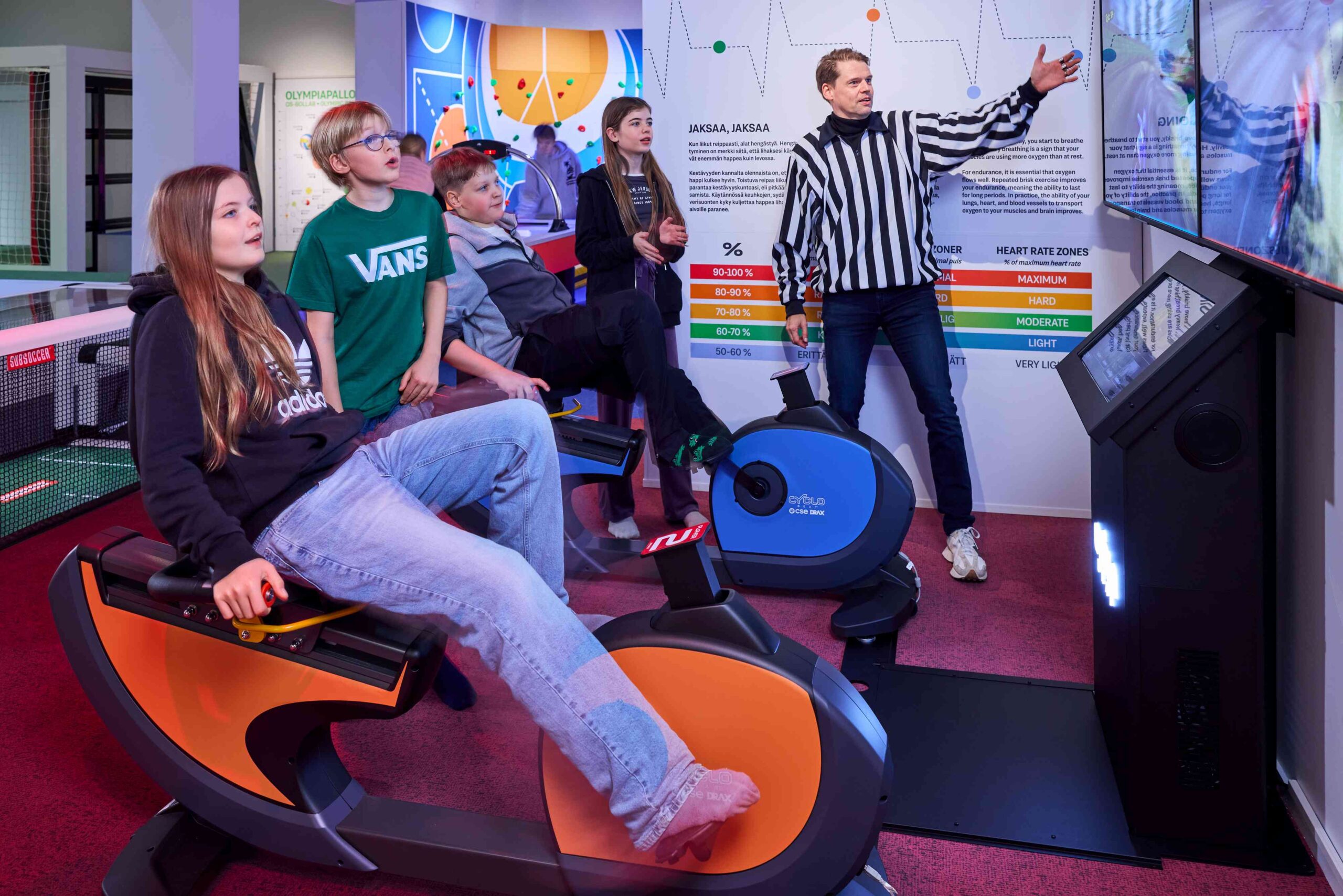
On a Monday in November, the exhibition space at TAHTO is calm. Only a small group of people are listening to a guide talk about the achievements of Jari Litmanen. However, the excited soundscape gives away that things are very different just around the corner. In the back hall, a group of fifth graders from Matinlahti School in Espoo are exploring TAHTO’s Sports Adventure.
Divided into four groups, the students try out all kinds of sports in a roughly 200-square-meter hall: a climbing wall, wheelchair basketball, virtual riding on exercise bikes, treadmills, disc throwing… altogether twelve different forms of physical activity divided into four different stations.
“Every 12 minutes they switch stations,” explains TAHTO’s Director of Sales and Customer Relations, Samuli Vasala.
“At first, we gave them 15 minutes per station, but in that time the kids managed to wear themselves out completely.”
That’s not hard to believe, judging by how enthusiastic they look. The intensity is also clear from the fact that the rowing machine that was part of the adventure is out of use. They quite simply rowed it to pieces.
Sports Culture Through Experience
A sports space aimed at children inside a museum might sound unusual – and this really is something new.
“In the museum context, approaching things through movement is new,” Vasala says.
It began when the museum, which has operated at Helsinki Olympic Stadium since 1938, needed more visitors to cover the increased rent caused by the stadium’s renovation.
That sparked the idea for a new kind of experiential museum visit, where sports culture and activation are at center stage.
“At the beginning of the visit, the children are taken into the exhibition and given the task of looking for information that helps them learn about local sports culture,” Vasala explains.
After that, they move on to the more experiential part. Even that, of course, isn’t just wild horseplay: while playing, they can also read about Finnish athletes and look, for example, at old sports equipment.
In the first trial year, the adventure’s popularity exceeded all expectations. They had planned for 6,000 group visits per year, and everything was fully booked already in February. Next year, the number of groups will have to be reduced to 4,000 per year, but there are plans to replicate the concept in different cities, including Espoo, Lahti, and Vantaa.
“In each city, it would of course be adapted to the local sports heritage.”
The core idea would still stay the same: presenting sports culture through hands-on doing.
In Line with the Basic Education Act
TAHTO is not alone in thinking about how to get elementary school children moving. Timo Jaakkola, Professor of Sport Pedagogy at the University of Jyväskylä, is launching a major intervention study. It will examine whether increasing physical activity during the school day could improve students’ well-being.
Children’s physical activity decreases as they progress through school. While 60 percent of seven-year-olds starting comprehensive school still move for the recommended one hour per day, by the end of basic education only 5 percent reach this level.
”Toivon uuden lain lisäävän liikkumista ja vähentävän liikkumattomuutta.”
Timo Jaakkola
“Here, the school day gives us an opportunity. It’s possible to build an hour of physical activity into the school day,” Jaakkola estimates.
“That means traveling to and from school using muscle power, being active during recess and lessons, and of course in PE classes as well.”
The new Basic Education Act, which will enter into force next year, supports the research. Under it, promoting a physically active lifestyle is also part of the school’s mission.
Jaakkola has been hoping for this reform for a long time.
“I hope the new law increases movement and reduces inactivity. That sitting will be broken up more often, that kids will go outside during recess, and that active, hands-on methods will be emphasized in teaching.”
Will Well-Being Improve?
The study is intended to consist of interventions in which elementary school teachers are trained to make better use of the opportunities within lessons and to add movement to other subjects as well. In addition, students will be encouraged to be active during recess and to complete at least part of their school journeys under their own steam. No new sports equipment will be bought for schools. The idea is to make use of what is already there. The study will not only look at ways to increase physical activity; it will also examine how increased activity shows up in young people’s well-being.
“Our idea is to measure, for example, sleep, mood, recovery, and social well-being,” Jaakkola says. The assumption is that even a small increase in movement has an effect. Now it just needs to be proven.
To make sure the study reflects the overall picture of basic education, it is being planned on a large scale. More than 30 schools are set to take part, with over 1,800 fifth graders in total. The Jane and Aatos Erkko Foundation has awarded a grant to carry out the pilot phase of the adventure. More definitive information on the results of the interventions can be expected in the coming years.
A Challenge from the Museum
But is increasing physical activity during the school day enough to boost children’s and young people’s enthusiasm for moving more broadly? Will it inspire a teenager to leave the screen and head out on a run?
“In the big picture, it obviously can only be part of the solution,” Jaakkola says.
“But on the other hand, in elementary school age kids learn patterns of behavior that may return to everyday life once the turbulence of puberty settles down.”
It’s no coincidence that it’s specifically fifth graders who are invited to the museum adventure. At that age, children also take part in the Move! test, which measures the physical functional capacity of students in basic education.
A one-hour museum visit, despite being memorable and experiential, will not by itself change exercise habits, TAHTO’s Samuli Vasala admits.
That’s why the Sports Adventure begins already before the visit. In preparation for TAHTO’s Sports Adventure, the classes work at school with learning materials produced by TAHTO about healthy lifestyles, sports culture, and getting people moving. The experience also continues after the visit.
“All the classes that have taken part in the adventure receive a challenge poster where they can write down their own class exercise challenge and then track how it progresses,” Vasala says.
The hope is that the joy of physical activity will continue for a long time after the adventure.